Direct Earnings Attachment Meaning: What It Is and How It Works
A payslip suddenly shows money missing, and no court letter ever arrived to explain why. That gap unsettles anyone who depends on a full wage to cover rent and bills. The cause is usually a Direct Earnings Attachment, a DWP order that pulls benefit debt straight from pay without a judge’s signature. This guide breaks down the direct earnings attachment meaning, the exact deduction rates, and the steps that protect your income.
What Does Direct Earnings Attachment Mean?
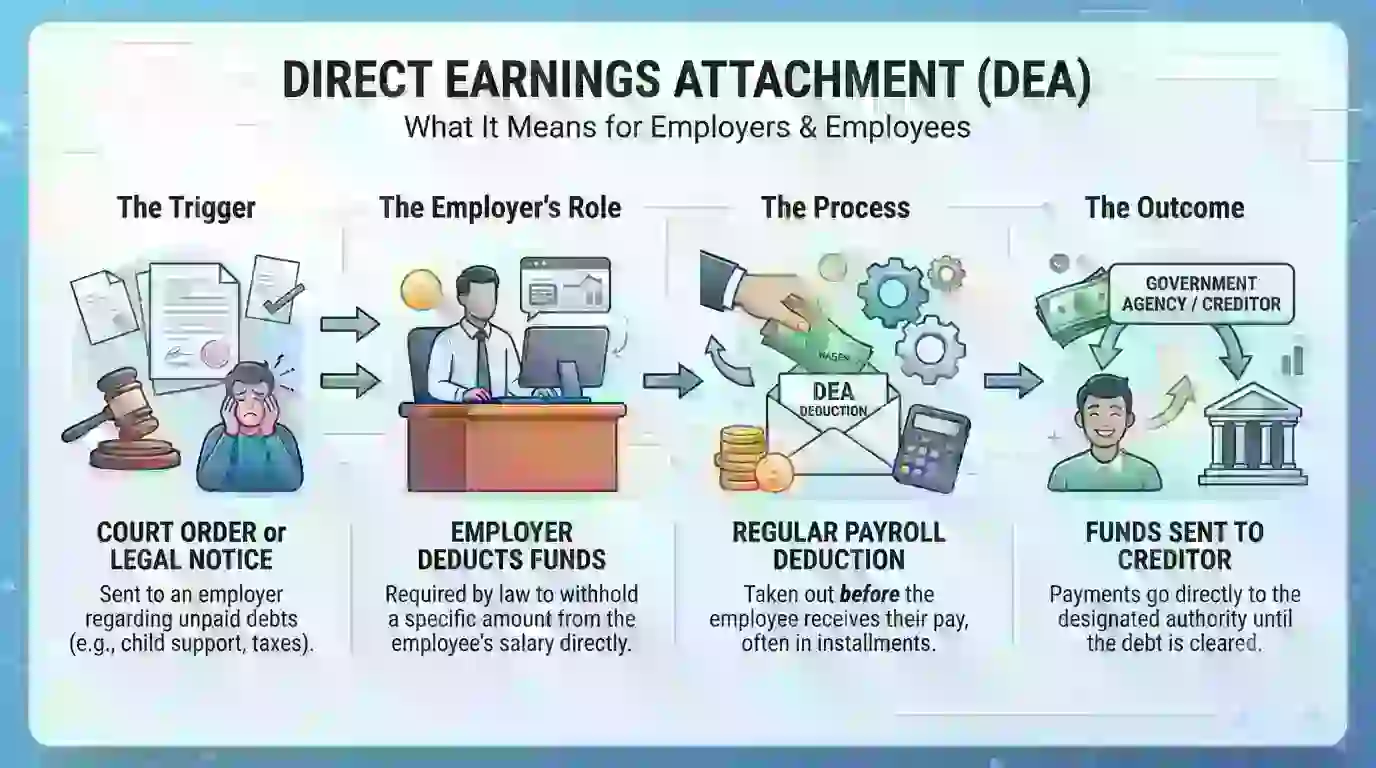
A Direct Earnings Attachment, shortened to DEA, is a formal instruction that tells an employer to take money from an employee’s wages. The Department for Work and Pensions issues it to recover benefit overpayments, tax credit debt, or Social Fund loans that a person has not repaid voluntarily.
The direct earnings attachment meaning rests on one detail that surprises most employees: a court order plays no part in it. <cite index=”1-1″>The Welfare Reform Act 2012 empowers the Department for Work and Pensions to request employers to operate a DEA without the need for a court order</cite>. The legal foundation sits in the Social Security (Overpayments and Recovery) Regulations 2013, which took effect on 8 April 2013.
A DEA differs from ordinary payroll deductions because the employer has no choice in the decision once a valid notice arrives. The employer calculates the figure, deducts it, and forwards the payment to DWP Debt Management every month.
How Do Direct Earnings Attachments Actually Operate?
The process follows a set sequence, and understanding each stage removes much of the confusion employees feel when deductions begin.
- DWP Debt Management identifies an unpaid benefit debt with no active repayment plan.
- The department attempts direct contact with the debtor to arrange voluntary repayment.
- When voluntary repayment fails, DWP writes to the employer with a formal DEA notice.
- The employer calculates the deduction using the correct rate table.
- The employer deducts the amount from net pay and sends it to DWP by the payment deadline.
A typical case unfolds over several months. DWP might send three or four letters over a twelve-week period, offer a repayment plan the person never confirms, and only then contact the employer. Most employees find out about the arrangement in writing before the first deduction, though a small number only notice it once a payslip changes.
<cite index=”4-1″>A government body identifies that an individual owes money for an overpaid social security benefit, has been unable to recover it voluntarily, and is now instructing the employer to recover it from wages on the government’s behalf</cite>. That single sentence captures the direct earnings attachment meaning better than any legal definition.
Why Would Someone Receive a DEA?
A DEA notice rarely appears out of nowhere. It follows a specific chain of events that usually starts months before the deduction ever reaches a payslip.
Common triggers include:
- Universal Credit overpayment, often caused by unreported changes in income or household circumstances.
- Tax credit debt carried over from the legacy benefits system.
- Budgeting Advance or Crisis Loan repayments that stalled after a change in circumstances.
- Housing Benefit overpayment, which local authorities recover using the same DEA mechanism.
- Ignored repayment letters, where DWP tried voluntary recovery first and received no response.
DWP treats a DEA as a last resort rather than a first step. Debt Management typically writes several times, offers a repayment plan, and only escalates to the employer once those attempts go unanswered.
Knowing which trigger applies to a specific case helps an employee know exactly who to contact for a review, since Universal Credit queries, tax credit queries, and Housing Benefit queries often sit with different teams inside DWP or the local council.
Who Can Issue a Direct Earnings Attachment?
Two bodies hold this power in Great Britain.
- The Department for Work and Pensions issues a DEA for benefit overpayments, Universal Credit debt, and Social Fund loans.
- Local authorities issue a similar order to recover overpaid Housing Benefit.
Northern Ireland runs its own version of the scheme. The Department for Communities Debt Management handles Northern Ireland cases directly, separate from the DWP process used in England, Scotland, and Wales.
Readers outside the UK sometimes search for a familiar comparison. <cite index=”4-2″>In the United States, the functional equivalent of a DEA is wage garnishment</cite>, though the two systems differ sharply in court involvement, deduction limits, and employer obligations.
Direct Earnings Attachment vs Attachment of Earnings Order
A DEA and an Attachment of Earnings Order (AEO) are sometimes confused, but they operate quite differently.
| Feature | Direct Earnings Attachment (DEA) | Attachment of Earnings Order (AEO) |
|---|---|---|
| Issued by | DWP or a local authority | County court |
| Court order required | No | Yes |
| Typical debt | Benefit overpayment, Social Fund loan | Council tax, fines, civil debt |
| Employer discretion | None once notice arrives | None once order arrives |
| Governing law | Social Security (Overpayments and Recovery) Regulations 2013 | Attachment of Earnings Act 1971 |
A DEA never replaces a Council Tax Attachment of Earnings Order (CTAEO) or a Deduction from Earnings Order (DEO) for child maintenance. When several orders apply to one employee at once, priority orders such as child maintenance deductions get calculated first, and the DEA amount adjusts around them.
Payroll teams sometimes receive two or three separate orders for the same employee within a short period. Working through them in the correct priority sequence, rather than simply stacking every deduction together, is the only way to stay within the 60% protected earnings limit that applies across the board.
Standard Rate vs Higher Rate: The DEA Deduction Table
DWP applies one of two percentage bands, and the notice sent to the employer states which one applies. DWP decides which rate to use based on the size of the debt, how long recovery has already taken, and whether the debtor previously agreed to a repayment plan that later broke down.
- Standard rate: <cite index=”1-2″>Deducts up to 20% of net earnings</cite>.
- Higher rate: <cite index=”1-2″>Deducts up to 40% of net earnings at the higher rate</cite>.
The exact percentage depends on how much the employee earns in each pay period. The table below shows the official banding for weekly and monthly pay.
DEA Standard Rate Table
| Net earnings (weekly) | Net earnings (monthly) | Standard rate deduction |
|---|---|---|
| Up to £100 | Up to £430 | Nil |
| £100.01 – £160 | £430.01 – £690 | 3% |
| £160.01 – £220 | £690.01 – £950 | 5% |
| £220.01 – £270 | £950.01 – £1,160 | 7% |
| £270.01 – £375 | £1,160.01 – £1,615 | 11% |
| £375.01 – £520 | £1,615.01 – £2,240 | 15% |
| Over £520 | Over £2,240 | 20% |
DEA Higher Rate Table
| Net earnings (weekly) | Net earnings (monthly) | Higher rate deduction |
|---|---|---|
| Up to £100 | Up to £430 | 5% |
| £100.01 – £160 | £430.01 – £690 | 6% |
| £160.01 – £220 | £690.01 – £950 | 10% |
| £220.01 – £270 | £950.01 – £1,160 | 14% |
| £270.01 – £375 | £1,160.01 – £1,615 | 22% |
| £375.01 – £520 | £1,615.01 – £2,240 | 30% |
| Over £520 | Over £2,240 | 40% |
A worked example makes the direct earnings attachment meaning concrete. An employee paid £385 net per week sits in the £375.01–£520 band, so the standard rate applies at 15%, producing a weekly deduction of £57.75.
What Counts as Earnings Under a DEA?
Not every payment on a payslip qualifies for a DEA deduction. Wages, salary, overtime, bonuses, and most occupational pensions count as earnings.
Certain payments stay outside the calculation entirely:
- Statutory Sick Pay is included, but Statutory Maternity, Paternity, and Adoption Pay are excluded.
- Redundancy payments and pay in lieu of notice do not count.
- Expense reimbursements tied directly to the job do not count.
- Armed forces pay and allowances fall outside the scope of a DEA.
An employer who only pays an employee through excluded categories cannot calculate a deduction for that pay period at all.
Commission and performance bonuses do count as earnings, which means a strong sales month can temporarily push an employee into a higher deduction band. Holiday pay follows a special rule: when an employee receives several weeks of holiday pay in one lump sum, the employer averages the total across the number of weeks covered before checking the rate table, rather than treating the whole payment as one week’s earnings.
Protected Earnings: How Much Must an Employee Keep?
Every DEA calculation respects one hard limit. <cite index=”5-1″>The employer must consider the Protected Earnings amount, which equals 60% of an employee’s net earnings</cite>.
This rule means an employee always keeps at least 60% of net pay, even when several deduction orders apply at the same time. Combine the DEA with a child maintenance order and a council tax order, and the total of all three still cannot push the employee’s take-home pay below that 60% threshold.
<cite index=”5-2″>An employer may take up to £1.00 from an employee’s earnings towards administrative costs for each pay period a DEA applies, even if it reduces income below the protected earnings amount</cite>. The one exception: this small fee cannot push pay below the National Minimum Wage.
Here is how the limit plays out with real figures. An employee earning £1,620 net per month falls into the 30% higher rate band, which suggests a deduction of £486. If that employee already has a £324 child maintenance order in place, the combined deductions cannot exceed 40% of net pay, or £648. Subtracting the existing £324 order leaves only £324 available for the DEA that month, even though the rate table alone pointed to £486.
Employer Responsibilities When Operating a DEA
Employers carry legal duties the moment a DEA notice lands, and ignoring them carries real financial risk. Payroll teams that treat the notice as an ordinary deduction request, rather than a legal obligation with its own deadlines, are the ones most likely to face a penalty later.
- Calculate the correct percentage using the relevant rate table.
- Deduct the amount from net earnings each pay period.
- Notify the employee in writing before the first deduction.
- <cite index=”8-1″>Remit payments to DWP Debt Management by the 19th of the following month</cite>.
- Keep accurate records of every deduction and the employee it relates to.
- Continue the DEA until DWP confirms the debt is cleared or the employee leaves the company.
<cite index=”8-2″>Failure to process a DEA correctly can result in a statutory fine of up to £1,000 per notice</cite>. Some employers qualify for an exemption. A business that started trading recently, or one with fewer than ten employees, can choose whether to operate a DEA rather than being legally required to.
Employee Rights: What to Do If You Disagree With a DEA
Employees are not powerless once a DEA notice reaches their employer. If an employee is having financial difficulties, they can request a review by contacting the issuing authority, such as the Department for Work and Pensions or the court.
Practical steps worth taking immediately:
- Ask the employer for a copy of the written deduction notice.
- Check the net earnings figure used against the correct rate table.
- Contact DWP Debt Management directly to query the debt amount or dispute an error.
- Request a temporary reduction if the deduction causes genuine hardship.
- Confirm the protected earnings calculation actually left 60% of net pay intact.
Regularly checking payslips against the rate table catches employer errors early, before overpayment or underpayment becomes a bigger problem to unwind.
Keeping copies of every letter from DWP and every payslip affected by the DEA gives an employee solid evidence if a dispute ever needs to go further, such as to an independent review of the original benefit decision.
How Long Does a DEA Last?
There is no fixed term written into the rules. A DEA runs for as long as the debt takes to clear at the applicable rate, which can range from a few months for a small overpayment to several years for a larger one.
Three events end a DEA:
- DWP confirms the balance has been repaid in full.
- The employee pays off the remaining amount directly with DWP Debt Management.
- DWP instructs the employer in writing to stop the deduction, which can happen after a successful dispute or a change in circumstances.
An employer must never assume a DEA has ended without written confirmation, since continuing or stopping deductions on a guess creates compliance risk either way.
Can a Direct Earnings Attachment Affect Credit Scores or Future Borrowing?
A DEA itself does not appear on a standard credit report the way a County Court Judgment does, because no court is involved in issuing it. Credit reference agencies do not receive automatic notification of a DEA from DWP.
The debt behind the DEA can still influence finances indirectly. Reduced take-home pay for the length of the repayment period can affect affordability assessments for mortgages, car finance, or new credit applications, since lenders look at disposable income as much as credit history.
Bank statements shared with a lender will still show the lower net deposit each payday, even though the deduction itself carries no separate credit marker. Anyone applying for a mortgage or a large loan during an active DEA should factor the reduced income into their own budget calculations before submitting an application.
How to Stop or Reduce a Direct Earnings Attachment
A DEA ends once the underlying debt is cleared in full, but employees do not have to wait passively for that day.
- Negotiate a voluntary repayment plan directly with DWP Debt Management to potentially lower the monthly amount.
- Request a hardship review if the standard or higher rate deduction leaves too little to live on.
- Pay off the remaining balance in one lump sum where finances allow it, which ends the DEA immediately.
- Query the debt itself if the overpayment calculation looks incorrect, since a successful challenge can reduce or cancel the balance owed.
Employers must stop deductions the moment DWP confirms the debt is settled, and any deduction taken after that point should be refunded promptly.
Direct Earnings Attachment for Self-Employed Workers and Multiple Jobs
A DEA only works through PAYE payroll, so it cannot be applied directly against self-employment income. DWP uses separate recovery routes, such as direct deductions from ongoing benefit payments, when a debtor works for themselves.
Employees with two or more jobs can still face a DEA on either employment, since the deduction attaches to whichever PAYE record DWP has on file. Changing jobs during an active DEA does not cancel the debt. The new employer typically receives a fresh notice once DWP updates its records through HMRC’s Real Time Information system.
Zero-hours and variable-hours workers face a slightly different calculation each pay period, since net earnings change week to week. The rate table still applies fresh at every payday, so a quiet week can drop an employee into a lower band or clear of deductions entirely, while a busy week can push them into a higher one. Payroll software that recalculates the band automatically avoids the manual errors that come with fluctuating hours.
Common Mistakes Employers Make With DEA Deductions
Payroll teams handling their first DEA notice tend to repeat the same avoidable errors, most of which trace back to unfamiliarity rather than carelessness.
- Applying the wrong rate table, such as using higher rate figures when the notice specifies standard rate.
- Forgetting to recalculate the protected earnings amount when other deduction orders already exist.
- Missing the monthly payment deadline to DWP Debt Management, which risks a fine.
- Failing to notify the employee in writing before the first deduction is taken.
- Continuing deductions after DWP has confirmed the balance is cleared.
Building a simple checklist into payroll software prevents most of these issues before they ever reach an employee’s payslip. Training even one member of the payroll team as a specialist point of contact for attachment orders cuts down on repeated errors across every future DEA notice the business receives.
Frequently Asked Questions
What does direct earnings attachment mean in simple terms?
It means the DWP has told an employer to take benefit debt repayments straight from an employee’s wages, without going through a court first.
Can an employer refuse to operate a direct earnings attachment?
Only if the business has fewer than ten employees or started trading very recently. Every other employer must comply once a valid notice arrives, and ignoring it risks a fine of up to £1,000.
How much can be deducted under a DEA?
Between nil and 20% of net earnings at the standard rate, or up to 40% at the higher rate, depending on the employee’s pay band.
Does a DEA appear on a credit report?
No. A DEA is not a court judgment, so it does not register on standard credit files the way a CCJ would.
What happens to a DEA if an employee changes jobs?
The debt continues. DWP typically identifies the new employer through payroll records and issues a fresh notice to continue collection.
Can someone pay off a direct earnings attachment early?
Yes. Settling the outstanding balance directly with DWP Debt Management in one payment ends the deduction immediately, and the employer should stop taking money the very next pay period once DWP confirms the balance is clear.
Take Control of Your DEA Today
Understanding the direct earnings attachment meaning turns a confusing payslip deduction into a manageable, time-limited process. Check the rate table against your own pay band, confirm your protected earnings are intact, and contact DWP Debt Management directly the moment a deduction looks wrong.
Save this guide, share it with a colleague in payroll, and revisit the rate tables whenever a pay rise or new job might shift the deduction band. A five-minute check today can save weeks of back-and-forth with DWP later, and it keeps more of every wage exactly where it belongs: in your bank account.