Forget-Me-Not Flower Meaning: Symbolism, Colors, and Legends Explained
You spotted a cluster of tiny blue flowers and wondered what they were trying to say. Forget-me-nots carry more weight than their size suggests, tied to love, loss, and memory across centuries. Get the meaning wrong, and a gift can send the wrong signal entirely. This guide breaks down the forget-me-not flower meaning by color, culture, and occasion, so you say exactly what you intend.
What Is the Forget-Me-Not Flower Meaning?
At its core, the forget-me-not flower meaning centers on three ideas: true love, remembrance, and loyalty. The name itself is a direct request — don’t forget me — which makes it one of the most literal flowers in the entire language of blooms.
People give forget-me-nots when words alone feel too small. A partner heading off on deployment, a friend moving across the country, or a family remembering someone they’ve lost all reach for this small blue flower because its message needs no explanation.
Unlike roses or lilies, forget-me-nots don’t rely on elaborate symbolism built over time. Their meaning grew directly from a story, and that story still shapes how the flower gets used today.
Quick Facts: Forget-Me-Not at a Glance
Here’s a snapshot of the plant itself before diving into its symbolism.
| Detail | Information |
|---|---|
| Genus | Myosotis |
| Plant Family | Boraginaceae |
| Common Species | Myosotis sylvatica, Myosotis scorpioides, Myosotis alpestris |
| Name Origin | Greek myos (mouse) + otis (ear), for the leaf shape |
| Native Range | Europe and Asia, now naturalized worldwide |
| Flower Colors | Blue (most common), pink, white |
| Petal Count | 5, with a small yellow center |
| Bloom Season | Spring through early summer |
| Official State Flower | Alaska (territorial emblem since 1917, state flower since 1959) |
| Core Symbolism | True love, remembrance, loyalty, faithful memory |
| Popular Era | Victorian language of flowers (floriography) |
Keep this table handy. Every section below expands on one of these entries.
Where Does the Name “Forget-Me-Not” Come From?
The English name is a direct translation of the German phrase Vergissmeinnicht. Nearly every European language uses some variation of the same phrase, which is unusual for a common flower name.
That consistency across languages hints at how deeply the story behind the name traveled. Germany gets the credit for popularizing it, but France, Italy, and Scandinavia all adopted a near-identical translation centuries ago.
The Medieval Legend Behind the Forget-Me-Not Flower Meaning
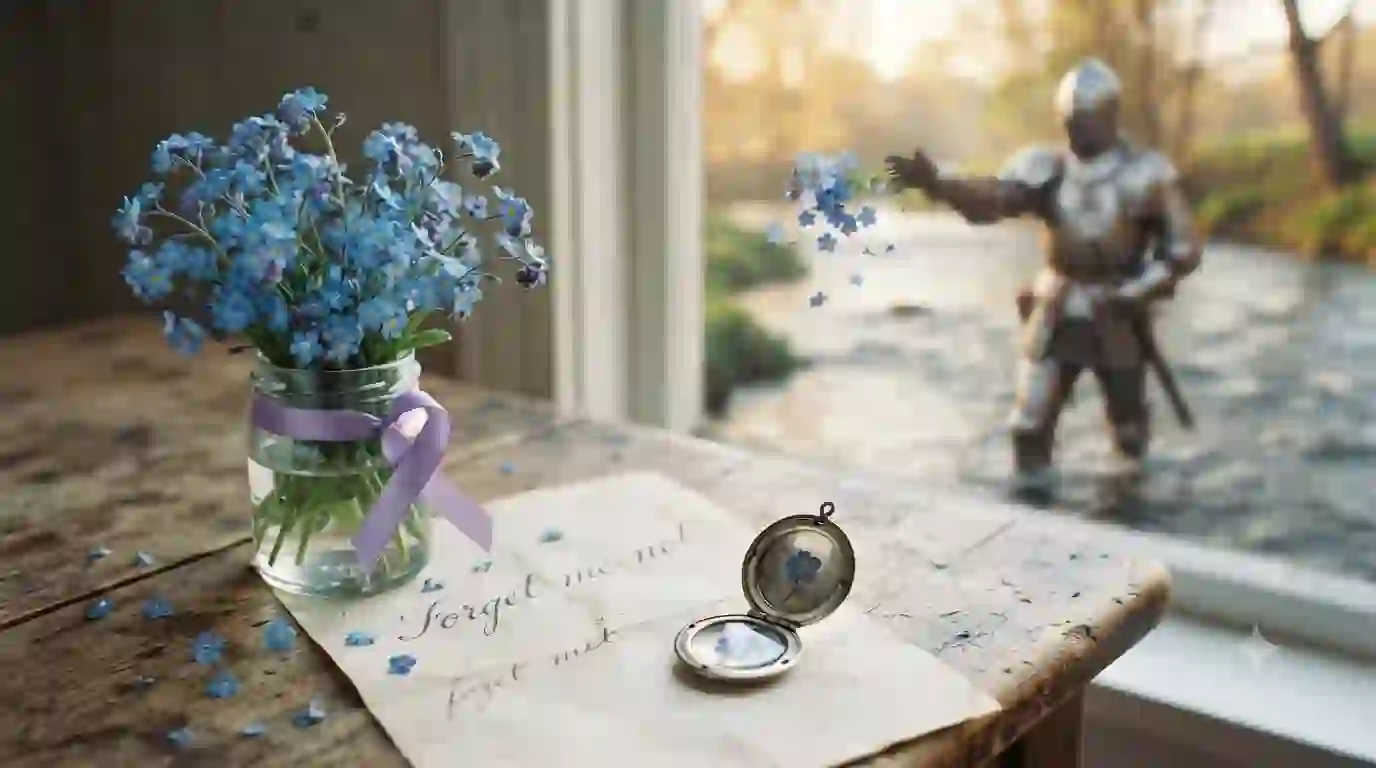
The most repeated origin story dates back to medieval Germany. A knight was walking along the banks of the Danube River with the woman he loved when he noticed small blue flowers growing near the water.
He waded in to pick a bouquet for her. His armor pulled him under, and as the current swept him away, he threw the flowers to shore and called out, “Vergiss mein nicht!” She wore them in her hair for the rest of her life.
A second, gentler legend exists too. In this version, God finished naming every plant in creation, only to notice one small flower had been overlooked. When it cried out, “Forget me not, O Lord,” God gave the plant that very name.
Both stories point to the same idea: a small, unassuming flower carrying an outsized emotional request. That tension between size and meaning is exactly why the forget-me-not flower meaning still resonates today.
Forget-Me-Not Flower Meaning by Color
Color changes the message, even within a single flower type. Use this table to match the shade to the sentiment you actually want to send.
| Color | Meaning | Best Used For |
|---|---|---|
| Blue | True love, fidelity, trust | Anniversaries, long-distance relationships, weddings |
| Pink | Gentle affection, nurturing bonds | New relationships, mother-child gifts, thank-you bouquets |
| White | Purity, innocence, remembrance | Funerals, memorial gardens, sympathy arrangements |
Blue remains the default and most widely recognized version. If you’re building a bouquet around a specific message, pairing blue forget-me-nots with white ones works well for combined “love and remembrance” arrangements.
Forget-Me-Not Meaning in the Victorian Language of Flowers
Floriography, the Victorian practice of assigning meaning to flowers, gave the forget-me-not a formal place in coded communication. At a time when open declarations of love were often considered improper, flowers carried the message instead.
A gift of forget-me-nots during this era signaled a promise: I will remember you, and I expect the same in return. Soldiers heading off to war and lovers separated by distance relied on the flower to say what letters couldn’t fully capture.
That Victorian association with fidelity during separation is one reason the flower still appears in military remembrance ceremonies today.
Forget-Me-Not as a Symbol of Remembrance and Loss
Beyond romance, the forget-me-not carries a second, equally strong meaning tied to grief and memory. Families plant them in memorial gardens. Mourners choose them for funeral arrangements. Communities use them in ceremonies honoring people who died in service to others.
This dual meaning, love and loss sitting side by side, isn’t a contradiction. Both draw from the same root idea: a wish that connection continues even when someone is gone or far away.
That’s part of why the forget-me-not flower meaning translates so easily across very different situations, from a wedding bouquet to a headstone marker.
Forget-Me-Not in Culture, History, and Awareness Causes
Few flowers carry this many separate symbolic roles at once. The table below lays out the major ones.
| Cause or Region | What the Flower Represents |
|---|---|
| Alaska, USA | Official state flower, adopted as a territorial emblem in 1917 and confirmed at statehood in 1959 |
| Alzheimer’s and dementia awareness | A widely used symbol representing memory and support for those living with memory loss |
| Freemasonry | Loyalty and quiet remembrance, historically worn as a discreet sign of unity during periods of persecution |
| Armenian communities worldwide | Used during the Armenian Genocide Centennial in 2015 as a symbol of remembrance |
| Newfoundland, Canada | Worn to honor soldiers lost in the First and Second World Wars |
| International Missing Children’s Day | A symbol of hope for the safe return of missing children |
That range, from state symbol to advocacy icon, shows how flexible the flower’s core meaning really is. Remembrance, once attached to a person, adapts easily to a cause.
Forget-Me-Not in Literature and Art
Writers have leaned on the forget-me-not for centuries precisely because its name does half the emotional work already. References to the flower appear in the work of poets exploring memory, loss, and devotion, and it shows up again in folk art, embroidery, and Victorian keepsake jewelry.
That staying power in creative work isn’t an accident. A flower whose name is already a full sentence gives writers and artists an emotional shortcut few other blooms offer.
Is the Forget-Me-Not Flower Meaning Different Across Cultures?
Short answer: The core meaning stays consistent, but emphasis shifts by region.
In Europe, the romantic legend dominates, and the flower leans toward love and fidelity. In North America, the same flower carries added weight through causes like Alzheimer’s awareness and missing children’s advocacy. In parts of Asia, native Myosotis species grow wild and hold more understated, less codified symbolism than in the West.
- Europe: Romantic devotion, marital fidelity, wartime remembrance
- United States and Canada: Memory-related advocacy, state pride (Alaska), military remembrance
- East Asia: Wild native species valued more for garden beauty than formal symbolism
Knowing the regional emphasis helps you pick the right message if you’re sending flowers internationally or writing for a global audience.
How to Use the Forget-Me-Not Flower Meaning in Gifts and Occasions
Matching the flower to the right moment makes the gesture land the way you intend. Consider these common pairings:
- Long-distance relationships: Blue forget-me-nots signal “I remember you” across the distance.
- Sympathy and memorial gifts: White forget-me-nots offer comfort without feeling as heavy as an all-white funeral arrangement.
- Grandparent or new-mother gifts: Pink varieties bring warmth without romantic undertones.
- Awareness events: Blue forget-me-not pins or badges support Alzheimer’s and dementia fundraising events.
- Anniversary bouquets: Pair with roses to combine passionate love with lasting fidelity.
A short, handwritten note explaining the flower’s meaning often means more to the recipient than the bouquet size ever could.
Growing Forget-Me-Nots: A Quick Note for Gardeners
Forget-me-nots thrive in partial shade and consistently moist, well-drained soil, which makes them a natural fit for woodland gardens and shaded borders. They self-seed readily, so a single packet can fill a garden corner for years without replanting.
Gardeners in USDA zones 5 through 9 generally have the easiest results. In several regions, including parts of the American Midwest, the plant naturalizes so easily that it’s classified as a mildly invasive species, so keep an eye on unwanted spread if you plant it near a wild area.
Is the Forget-Me-Not Flower Safe to Touch or Eat?
Short answer: Treat forget-me-nots as an ornamental plant only, not a food or remedy.
Myosotis species contain natural compounds that can cause stomach upset if eaten in quantity, and they aren’t intended for consumption. Keep them out of reach of small children and pets who might chew on garden plants, and always wash your hands after heavy garden work, as a general precaution with any wild or garden plant.
Frequently Asked Questions
What is the forget-me-not flower meaning in one sentence? It represents true love, remembrance, and loyalty, rooted in a medieval legend where a drowning knight asked never to be forgotten.
Why is the forget-me-not associated with Alzheimer’s disease? Because the flower’s core meaning is about memory, awareness organizations adopted it as a natural symbol for supporting people living with memory loss and their caregivers.
What does a blue forget-me-not symbolize compared to other colors? Blue represents true love, fidelity, and trust, while pink signals gentle affection and white leans toward purity and remembrance of someone who has passed.
Is the forget-me-not a real state flower? Yes. It has been Alaska’s official state flower since 1959, following its earlier adoption as the Alaska Territory’s floral emblem in 1917.
Can you give forget-me-nots for both romantic and sympathy occasions? Yes, and that flexibility is part of what makes the forget-me-not flower meaning so useful. Blue works well for romance, while white suits sympathy and memorial settings.
Are forget-me-nots easy to grow at home? Generally, yes. They prefer partial shade and moist soil, self-seed readily, and perform well in USDA zones 5 through 9 with minimal maintenance.
Final Thoughts
The forget-me-not earns its place among the most meaningful flowers in the world without needing size or spectacle to do it. A single stem carries a legend, a cause, and a promise, all inside five small petals.
Next time you’re choosing flowers for someone you don’t want to lose touch with, skip the guesswork and reach for forget-me-nots. If you’ve already given or received them, share the story behind your bouquet in the comments below.