Head Over Heels Meaning: The Origin, Psychology, and Real Definition
Someone told you they’re “head over heels” for a new partner, and you nodded along. But stop for a second: your head is already over your heels right now, standing still, reading this. So why does that image describe falling in love? This guide unpacks the real head over heels meaning, its odd backwards history, and what your brain is actually doing when it happens.
What Does “Head Over Heels” Really Mean?
The head over heels meaning today is simple: to be completely, overwhelmingly in love or excited about someone or something. It describes a feeling so strong it knocks you off balance, emotionally if not physically.
People almost always pair it with love: “head over heels in love.” But the phrase also works for non-romantic excitement, like feeling this way about a new job or a long-awaited move.
Three qualities define the modern head over heels meaning:
- Intensity — the feeling is strong, not mild or casual.
- Suddenness — it often arrives fast, catching the person off guard.
- Loss of control — the person feels swept along rather than calmly choosing.
Knowing this offers you the entire meaning of “head over heels,” not simply the romantic-comedy version that people often quote without giving it much thought.
Where Does “Head Over Heels” Come From?
Here’s the detail most people miss: the phrase used to make perfect sense, and then English broke it.
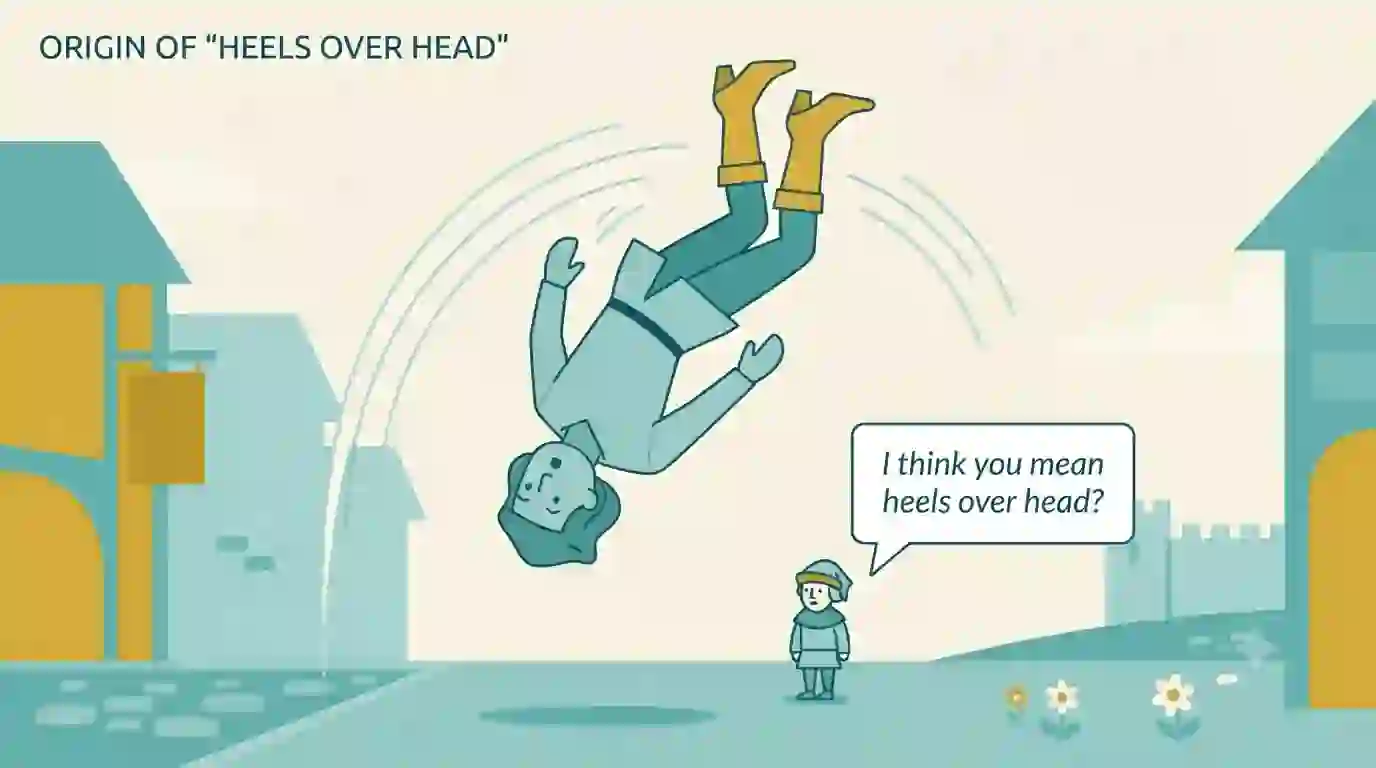
The original version, recorded from the late 1300s, was “heels over head.” That phrase described someone genuinely upside down, mid-tumble, heels pointed toward the sky. It was a literal description of a fall or a somersault, nothing romantic about it.
Writers started flipping the words sometime in the 1700s. Merriam-Webster traces the earliest romantic use to a 1711 translation of the ancient Greek writer Lucian, where a lovesick character is described as “reeling and tumbling Head over Heels” in a state of distracted longing. For decades afterward, both the tumbling sense and the falling-in-love sense existed side by side in print.
By the 1800s, “head over heels” had fully taken over the romantic meaning, even though the wording technically describes your normal, upright, everyday stance. The phrase finder resource Phrases.org.uk documents Herbert Lawrence’s 1771 book The Contemplative Man as one of the earliest printed uses of that exact word order.
Why the Phrase Is not Really Logical
This is the part that trips people up, and it’s worth sitting with for a moment.
Your head sits over your heels all day, every day. That’s just standing. The original phrase, “heels over head,” was the one that made sense: it described your body flipped upside down, which is genuinely unusual and dramatic.
So how did the “wrong” version win? Language doesn’t always follow logic. Once enough writers and speakers repeated this new order, it stopped mattering that the image was backwards. The phrase kept its emotional punch even after it lost its physical accuracy.
That mix-up is actually part of the charm behind the head over heels meaning. Falling in love rarely makes sense in the moment either.
How Psychologists Describe the Head Over Heels Feeling
Psychology has its own word for this intense early stage: limerence. It describes the involuntary, consuming infatuation people feel at the start of romantic attraction, before real attachment has had time to form.
Limerence explains the head over heels meaning in clinical terms. It’s not the same as lasting love. It’s a temporary, high-intensity state your brain uses to pull you toward a new connection.
Common features of this state include:
- Constant, intrusive thoughts about the other person.
- Idealizing them, focusing on their best traits while overlooking flaws.
- Strong physical reactions: racing heart, restlessness, loss of appetite.
- Craving reciprocation, checking your phone, replaying conversations.
What Happens in Your Brain When You Fall Head Over Heels
The feeling isn’t just emotional. It’s chemical, and researchers have watched it happen in real time.
Harvard Medical School reports that early romantic attraction floods the brain’s reward circuit with dopamine, the same system activated by pleasurable rewards and, at higher intensity, by substances like cocaine. That flood is why new love can feel euphoric and almost addictive.
At the same time, cortisol (a stress hormone) rises, and serotonin drops. Lower serotonin is linked to the racing, repetitive thoughts people report when they can’t stop thinking about someone new. Oxytocin, the hormone most associated with long-term bonding, is already present in small amounts even at this early stage, quietly laying groundwork for the attachment that may come later.
| Brain Chemical | What Rises or Falls | What You Feel |
|---|---|---|
| Dopamine | Rises sharply | Euphoria, motivation, craving their attention |
| Cortisol | Rises | Nervous energy, a racing heart, mild stress |
| Serotonin | Drops | Obsessive, repetitive thoughts about them |
| Norepinephrine | Rises | Alertness, sweaty palms, that “butterflies” feeling |
A landmark 2005 study led by biological anthropologist Helen Fisher scanned the brains of people looking at photos of someone they loved. Their brains lit up in dopamine-rich regions, giving the head over heels meaning real neurological evidence instead of just poetic language.
Head Over Heels vs. Real, Lasting Love
Not every early spark turns into something lasting, and that’s normal. The two states run on different systems.
| Head Over Heels (Limerence) | Lasting, Attached Love | |
|---|---|---|
| Timeframe | Weeks to about 18 months | Ongoing, builds over years |
| Main hormone | Dopamine-driven | Oxytocin and vasopressin-driven |
| Feeling | Intense, urgent, consuming | Calm, secure, steady |
| Focus | Idealized version of the person | Realistic view, flaws included |
| Stability | Can swing between highs and lows | Generally stable day to day |
Neither stage is “fake.” Head over heels feelings are the spark. Lasting love is what gets built afterward, if both people choose to keep building it.
Signs You’re Head Over Heels for Someone
You might be in this state right now and not have the words for it. Common signs include:
- You think about them multiple times an hour, even during unrelated tasks.
- Small interactions (a text, a look) affect your mood for hours.
- You find yourself agreeing to things you’d normally think twice about.
- Their flaws feel minor or even charming right now.
- You feel nervous energy around them: sweaty palms, a faster pulse, tongue-tied moments.
None of these signs are a problem on their own. They only become worth watching if they start overriding your judgment about someone’s actual character.
Head Over Heels Examples in Everyday Life
Seeing the phrase in real sentences makes the head over heels meaning easier to apply. Here are natural, everyday uses:
- Romantic: “She’s been head over heels since their second date.”
- Family: “New parents are usually head over heels the moment they meet their baby.”
- Non-romantic excitement: “He’s head over heels about his new apartment.”
- Past tense reflection: “I was head over heels for my first job offer, until the workload hit.”
Notice the phrase always signals strong, positive, slightly overwhelming feeling, whether or not romance is involved.
Head Over Heels in Music, Movies, and Pop Culture
The phrase has had a long life outside dictionaries, which is part of why people search for its meaning daily.
Tears for Fears released the song “Head Over Heels” in 1985, using the phrase to describe love arriving before the singer had time to brace for it. The title has since been reused across songs, films, and even a jukebox musical built entirely around the band’s catalog.
You’ll also spot it in romantic comedies, wedding speeches, and greeting cards, almost always attached to a story about someone catching feelings faster than they expected to. Search interest in the exact phrase tends to spike around Valentine’s Day and wedding season, which tracks with when people are most likely to be describing or Googling the feeling in real time.
Similar Idioms and Phrases With the Same Meaning
English has several cousins to this idiom worth knowing:
- “Swept off my feet” — describes the same sudden, overwhelming pull toward someone.
- “Fell hard” — a shorter, blunter way to say the same thing.
- “Smitten” — a single word carrying the same intensity.
- “Love at first sight” — narrows the idea to the very first moment of attraction.
- “Heels over head” — the original, literal ancestor of the modern phrase.
All of them share the same core image: love arriving with enough force to knock you off your normal footing. Reaching for one of these alternatives every so often also keeps your writing or speech from leaning on a single idiom too heavily, which is good practice whether you’re texting a friend or drafting a wedding toast.
Common Mistakes People Make With This Phrase
A few mix-ups come up often enough to mention, and clearing them up rounds out the head over heels meaning nicely.
- Spelling it “head over heals.” A heel is part of your foot; a heal is what a wound does. Only “heels” is correct here, even though the words sound identical out loud.
- Confusing it with “head over ears.” This related idiom leans more toward being in over your head generally, whether that’s love, debt, or a messy situation, rather than romance specifically.
- Assuming it only fits new relationships. Long-married couples sometimes describe brief returns of that same intensity, often after a milestone like a reunion or an anniversary trip.
- Treating it as a guarantee. Feeling this way about someone says nothing about long-term compatibility on its own; it only describes the intensity of the feeling, not its accuracy.
Keeping these distinctions straight helps you use the phrase the way careful writers and speakers actually do.
Is Being Head Over Heels a Good Thing?
Mostly yes, with one caveat worth knowing.
The head over heels meaning plays out exactly as it sounds here: this stage feels wonderful, and it serves a real purpose. It motivates two people to spend time together, share personal details quickly, and build the early bond that longer-term attachment grows from. Most healthy relationships pass through it.
The caveat: because judgment gets cloudy during this stage, it’s worth staying grounded on a few basics even while enjoying the ride. Keep talking to friends and family, since outside perspective is exactly what gets crowded out first. Notice if someone consistently dismisses your boundaries, even while you feel dazzled. Give the relationship a little time before making major joint decisions, and treat any pressure to cut off your usual support system as a signal worth taking seriously rather than brushing aside.
How Long Does the Head Over Heels Feeling Last?
Most research points to a fairly consistent window, though it varies by person and relationship.
| Stage | Typical Timeframe | What’s Happening |
|---|---|---|
| Initial spark | First few days to weeks | Dopamine and norepinephrine surge; constant thinking about the person |
| Peak infatuation | 1 to 6 months | Idealization is strongest; small gestures feel huge |
| Gradual shift | 6 to 18 months | Dopamine intensity fades; realistic view of the person returns |
| Settled attachment | 18 months onward | Oxytocin-driven bonding replaces the “high”; calmer, steadier connection |
If the intensity fades and nothing replaces it, that’s worth paying attention to. If it fades into a calmer, still-caring connection, that’s the expected, healthy pattern.
Frequently Asked Questions
1. What does “head over heels” mean? It means being completely, overwhelmingly in love or excited about someone or something, often to the point of feeling swept off balance. It’s almost always used in a positive sense, most commonly paired with “in love.”
2. Where does the phrase “head over heels” come from? It comes from an older 14th-century phrase, “heels over head,” which literally described someone tumbling upside down. Writers began reversing the word order in the 1700s, and the romantic sense had fully taken hold by the 1800s.
3. Is “head over heels” always about romantic love? No. While romance is the most common use, people also say they’re head over heels about a new job, a new home, a pet, or any source of strong, sudden excitement.
4. What’s the difference between being head over heels and true love? Head over heels describes limerence, an intense but temporary early-stage infatuation driven largely by dopamine. Lasting love tends to be calmer and steadier, built on oxytocin-driven attachment that develops over months and years.
5. What is the opposite of “head over heels”? Phrases like “lukewarm,” “indifferent,” or “unmoved” work as opposites, describing a lack of strong feeling. There isn’t a single fixed idiom that serves as the exact opposite.
6. Is it normal to feel head over heels very quickly? Yes. Brain imaging research shows the reward circuits behind this feeling can activate within days of meeting someone. Quick doesn’t mean fake; it just means the early, dopamine-driven stage of attraction moves fast for most people.
Final Thoughts
The head over heels meaning has stayed remarkably stable for nearly 300 years, even while the wording flipped itself upside down along the way. It captures something real: a documented, brain-level response that motivates people to bond with someone new.
Knowing the science behind it doesn’t make the feeling less exciting. It just means you can enjoy the rush while staying aware that it’s one stage of a longer story, not the whole thing.
Think about the last time you felt this way about someone or something. Did it settle into something steadier, or did it fade once the newness wore off? That answer usually says more about the relationship than the feeling itself ever could.