What Are Brand Name Normalization Rules? A Complete Guide
Your product catalog probably lists “Nike,” “NIKE,” and “Nike Inc.” as three separate brands. That single gap in your brand name normalization rules distorts inventory counts, breaks product filters, and sends shoppers away empty-handed. Left unchecked, it also skews sales reports and wastes ad spend on the wrong SKUs. This guide gives you the exact rules, steps, and tools to fix brand data for good.
What Is Brand Name Normalization?
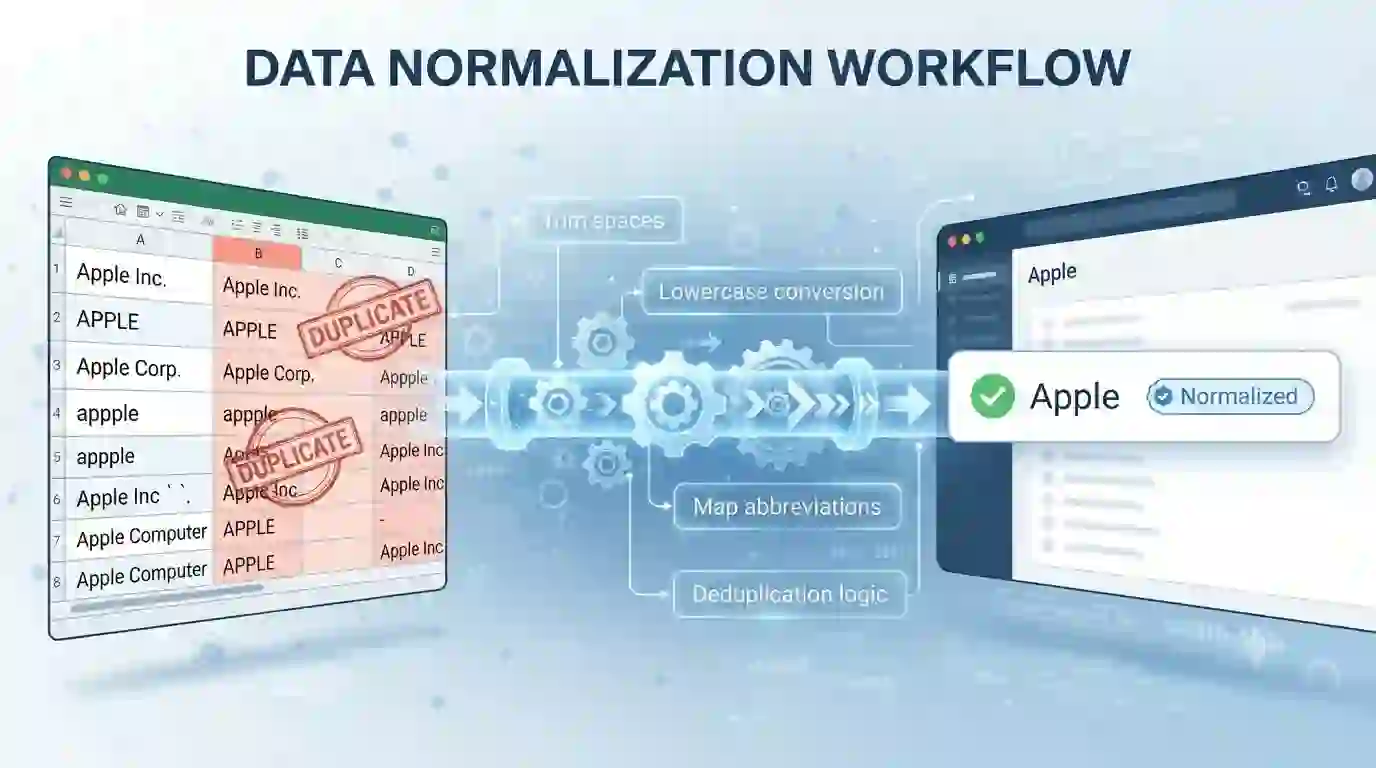
Short answer: Brand name normalization is the process of converting every spelling, spacing, and formatting variation of a brand name into one standard, canonical form so your systems treat it as a single entity.
Every catalog, CRM, or marketplace feed collects brand names from different sources: suppliers, sellers, scraped listings, and manual entry. Each source spells things its own way. One line might read “L’Oreal,” another “Loreal,” and a third “L’Oréal Paris.”
Without a shared standard, your database treats these as three unrelated brands instead of one. Applying consistent brand name normalization rules merges them into a single, searchable, reportable entity. This is the foundation of clean product data, accurate analytics, and reliable search results.
Why Brand Name Normalization Rules Matter for Your Business
Messy brand data does not stay contained in one spreadsheet. It spreads into search, reporting, advertising, and customer trust.
Here is what breaks when brand data goes unmanaged:
- Search and filters fail. A shopper who filters by “Adidas” misses listings tagged “adidas” or “ADIDAS AG.”
- Inventory counts inflate. The same product line appears as five separate brands, making stock levels look larger or smaller than reality.
- Reporting loses accuracy. Sales dashboards split revenue across brand variants instead of showing one true total.
- Ad spend gets wasted. Shopping campaigns bid on fragmented product groups instead of a unified brand strategy.
- Trust erodes. Customers who see the same brand spelled three different ways question the reliability of the entire catalog.
Strong normalization rules solve every one of these problems at the source, before bad data ever reaches a report or a shopper’s screen.
The cost compounds the longer it goes unaddressed. A catalog with 200 brand duplicates today often grows to 600 or more within a year, since every new supplier, seller, or scraped listing adds fresh variants on top of the old ones. Fixing the problem early is always cheaper than untangling it after it has spread through years of historical data.
Common Brand Name Variations That Break Your Data
Brand names get corrupted in predictable ways. Recognizing the pattern is the first step toward writing a rule that fixes it.
| Variation Type | Example Inputs | Normalized Output |
|---|---|---|
| Case differences | nike, NIKE, Nike | Nike |
| Punctuation and symbols | L’Oreal, L’Oréal, LOreal | L’Oréal |
| Legal suffixes | Nike Inc., Nike Corporation, Nike LLC | Nike |
| Spacing errors | Coca Cola, Coca-Cola, CocaCola | Coca-Cola |
| Abbreviations | P&G, PG, Procter and Gamble | Procter & Gamble |
| Diacritics and accents | Moet, Moët, Moet & Chandon | Moët & Chandon |
| Language variants | Google, グーグル, 谷歌 | Google (per target market) |
| Sub-brand confusion | Nike Air, Nike Running, Nike | Nike (parent) with sub-brand tag |
| Typos and OCR errors | Nikke, Nkie, Nlke | Nike |
| Trailing whitespace or hidden characters | “Nike ” (extra space), “Nike\u200b” | Nike |
Each row in this table represents a real failure point inside a product feed, CRM, or marketplace listing. A mature normalization rule set addresses all ten categories, not just the obvious case-sensitivity issue.
The Core Brand Name Normalization Rules Every Team Should Follow
These are the foundational rules that data engineering, e-commerce, and master data management teams rely on. Apply them in order for the cleanest results.
| Rule # | Rule Name | What It Fixes | Before | After |
|---|---|---|---|---|
| 1 | Case standardization | Inconsistent capitalization | nike, NIKE | Nike |
| 2 | Whitespace trimming | Leading, trailing, and double spaces | ” Nike “ | Nike |
| 3 | Punctuation stripping | Apostrophes, hyphens, periods | L’Oreal., Coca-Cola | LOreal, Coca Cola (then re-applied per canonical form) |
| 4 | Legal suffix removal | Inc., LLC, Corp., Ltd. | Nike Inc. | Nike |
| 5 | Diacritic mapping | Accented characters | Moet vs Moët | Moët |
| 6 | Abbreviation expansion | Shortened brand references | P&G | Procter & Gamble |
| 7 | Canonical dictionary matching | Known brand aliases | Coke | Coca-Cola |
| 8 | Sub-brand hierarchy tagging | Parent vs. child brand confusion | Nike Air | Nike (parent) → Air (sub-brand) |
| 9 | Duplicate detection and merge | Near-identical entries | Nikke, Nike | Nike |
| 10 | Source-of-truth validation | Unverified brand claims | Unknown seller-submitted name | Verified against brand registry |
Rules 1 through 5 handle formatting. Rules 6 through 10 handle meaning and identity. Both layers are necessary; formatting rules alone will not catch a shopper typing “Coke” when your canonical brand is “Coca-Cola.”
Step-by-Step Process to Normalize Brand Names in Your Database
Follow this sequence to apply brand name normalization rules across an existing dataset without breaking live listings.
- Audit your current brand field. Export a distinct list of every brand value currently in your system, along with a count of how many records use each one.
- Group near-duplicates. Sort the list alphabetically and manually scan for obvious variants, then use fuzzy matching software to catch the rest.
- Build a canonical brand table. Create a master reference list with one row per real brand, including every known alias, misspelling, and legal name.
- Write your mapping rules. Convert each brand name normalization rule from the table above into a script, spreadsheet formula, or ETL transformation.
- Run a test batch. Apply the rules to a sample of 500 to 1,000 records first and manually review the output before scaling up.
- Apply rules to the full dataset. Run the transformation across your entire product catalog, CRM, or database once test results look accurate.
- Set validation checks. Add automated alerts that flag any new brand value not found in your canonical table.
- Schedule ongoing reviews. Revisit your brand list monthly or quarterly, since new suppliers and sellers constantly introduce fresh variants.
Skipping the test batch in step five is the most common mistake teams make. A rule that looks correct on paper can accidentally merge two unrelated brands that happen to share a similar spelling.
Manual vs. Automated Brand Name Normalization: Which Wins?
Both approaches have a place, and most mature data teams use a mix of the two rather than picking one method for the entire catalog.
Manual normalization works well for small catalogs, high-stakes brand decisions, or edge cases that automated tools misclassify. A human reviewer can tell that “Apple” the tech brand and “Apple” the fruit supplier are not the same entity, something a simple matching script might miss.
Automated normalization scales. Once your canonical rules are defined, software can apply them to millions of records in minutes, something no manual team could match. Most mature operations start manual, document what they learn, then hand the repeatable patterns to automation while keeping a human in the loop for anything unusual.
| Factor | Manual Process | Automated Process |
|---|---|---|
| Speed | Slow, human-paced | Fast, processes bulk data instantly |
| Accuracy on edge cases | High | Moderate, needs human review layer |
| Cost at scale | Expensive | Low after initial setup |
| Consistency | Varies by reviewer | Fixed and repeatable |
| Best fit | Small catalogs, legal brand disputes | Large catalogs, marketplaces, ongoing feeds |
The strongest setup pairs automated rules for the first pass with a human review queue for anything the system flags as uncertain.
Techniques and Matching Methods Behind Effective Brand Name Normalization Rules
A few core techniques power most brand normalization workflows used in production systems today.
- Exact string matching compares values character by character. It catches identical duplicates but misses typos entirely.
- Fuzzy matching measures how similar two strings are, even with small differences. The Levenshtein distance algorithm, for example, counts how many single-character edits separate two brand names.
- Phonetic matching groups names that sound alike, such as “Nikee” and “Nike,” even when the spelling differs more than a simple edit-distance check would allow.
- Tokenization splits a brand name into individual words, which helps when word order changes, such as “Chandon Moët” versus “Moët & Chandon.”
- Canonical lookup tables store every known alias against one master brand ID, giving the system a definitive answer instead of a probability score.
- Machine learning classifiers learn from historical corrections and improve matching accuracy over time as more edge cases get reviewed.
Most production systems layer these techniques together. Exact matching handles the easy 80%, fuzzy and phonetic matching catch another 15%, and canonical lookup tables resolve the final edge cases that need a definitive answer. Running every record through the most expensive technique first wastes processing time, so most pipelines apply exact matching as an early filter and reserve fuzzy or phonetic checks for the smaller batch of records that fail the first pass.
A Real-World Example: Cleaning a Messy Brand Field Step by Step
Seeing the process applied to real data makes it easier to replicate. Imagine a mid-size retailer importing a supplier feed with the raw brand values below.
| Step | Raw Value | Rule Applied | Result |
|---|---|---|---|
| 1 | ” nike “ | Whitespace trimming | “nike” |
| 2 | “nike” | Case standardization | “Nike” |
| 3 | “Nike Inc.” | Legal suffix removal | “Nike” |
| 4 | “NIKKE” | Fuzzy match against canonical table (distance = 1) | “Nike” |
| 5 | “Nike Air Max” | Sub-brand hierarchy tagging | “Nike” (parent) → “Air Max” (sub-brand) |
| 6 | “adidas AG” | Case standardization + legal suffix removal | “Adidas” |
| 7 | “L’Oreal Paris” | Canonical dictionary matching | “L’Oréal” |
Five raw values collapsed into three real brands: Nike, Adidas, and L’Oréal. Before this pass, a filter search for “Nike” would have returned only the exact-match rows and missed three-quarters of the actual Nike inventory. After the pass, every listing surfaces correctly, and the sub-brand tag still preserves the useful detail that one product belongs to the Air Max line.
This kind of walkthrough is worth running on your own data before you write a single line of automation. It surfaces the specific variant patterns your suppliers actually produce, which is more useful than starting from a generic template.
Brand Name Normalization vs. Product Title Normalization: What’s the Difference?
These two processes get confused often, but they solve different problems.
Brand normalization focuses on a single field: the brand name itself. It answers one question: which real-world company or label does this value represent?
Product title normalization deals with the entire product name string, which usually includes the brand plus size, color, model number, and other descriptive text. A title like “Nike Air Max 90 Men’s Size 10 White” needs the brand extracted, the attributes parsed, and the remaining description cleaned up.
The two processes work together but require different logic. A canonical brand table feeds into title normalization, since the system needs to know “Nike” is a valid brand before it can correctly split a messy title into its component parts. Teams that skip brand-level cleanup first often end up parsing the same errors into every downstream title, which multiplies the original mistake instead of fixing it.
Brand Name Normalization for E-Commerce Catalogs and Marketplaces
Online marketplaces face this challenge at massive scale, since thousands of sellers submit product data through different formats every day.
Google Merchant Center, for instance, requires sellers to submit a single, consistent brand name for the [brand] attribute and explicitly warns against placeholder values like “N/A” or “Generic” (Google Merchant Center, brand attribute guidelines). A feed that fails this consistency check gets disapproved, which pulls the product from search results entirely.
GS1, the global standards body behind barcodes and product identifiers, defines the brand as the name a brand owner uses to uniquely identify a product line to the consumer, and its GTIN rules explain exactly when a primary brand change requires a new product identifier (GS1, Brand allocation rules). This standard exists precisely because inconsistent brand naming breaks supply chains as much as it breaks search.
Marketplaces that host thousands of independent sellers face an extra layer of difficulty: two sellers can list the identical product under slightly different brand spellings, and the platform has no way to know they are the same item unless its matching logic catches it. This is why large marketplaces invest heavily in seller onboarding checks, feed validation rules, and duplicate-listing detection long before a product page ever reaches a shopper.
Applying brand name normalization rules at the point of data intake, before a listing ever goes live, prevents these downstream disapprovals and keeps your catalog searchable. Building the check into the submission form, rather than relying on a cleanup script after the fact, stops most bad data before it ever enters the system.
Brand Name Normalization in CRM, ERP, and Master Data Management Systems
E-commerce catalogs are not the only place this problem shows up. Sales and operations teams face the same issue inside CRM and ERP platforms, where account records list the same customer’s employer as “Acme,” “Acme Corp,” and “Acme Corporation” across three different deals.
The Data Management Association’s DAMA-DMBOK framework treats this kind of consistency as a core data quality dimension, alongside accuracy, completeness, and timeliness (DAMA International, DMBOK framework). Master data management (MDM) programs exist specifically to enforce one authoritative record per real-world entity, brand names included, across every connected system.
A few practical patterns show up repeatedly in mature MDM setups:
- A single golden record per brand, stored in a master table that every other system references instead of storing its own local copy.
- API-level validation, where new brand values get checked against the canonical table the moment they are submitted, not after the fact during a nightly batch job.
- Cross-system syncing, so a correction made in the CRM automatically updates the same brand value in the ERP, the e-commerce platform, and the marketing database.
Without this kind of shared governance, each department ends up maintaining its own version of the truth, and rules applied correctly in one system quietly drift out of sync with the rest.
Brand Name Normalization for SEO, Structured Data, and AI Search
Search engines increasingly rely on structured entities rather than raw keywords to understand what a page is about. Schema.org’s Brand type defines a brand as a name used by an organization to label a product or product group, and it is nested inside Product schema markup to tell search engines exactly which entity a listing belongs to (Schema.org, Brand type).
When your brand name normalization rules are inconsistent, your structured data becomes inconsistent too. A search engine that sees “Nike” on one page and “NIKE Inc.” on another may treat them as separate entities, weakening the authority each page could otherwise share.
Consistent, normalized brand names strengthen entity recognition, help Google’s Merchant Center product data specification match your feed correctly, and improve your odds of appearing in rich results and AI-generated overviews (Google Merchant Center, product data specification).
Common Mistakes That Undermine Brand Name Normalization Rules
Even well-intentioned teams introduce new problems while trying to fix old ones. Most of these mistakes come from moving too fast on the merge step or treating the cleanup as a one-time task instead of an ongoing discipline. Watch for these mistakes:
- Over-aggressive merging. Combining two genuinely different brands because their names look similar creates a worse error than the original duplicate.
- Ignoring sub-brands. Treating “Nike Air Jordan” and “Nike” as identical erases useful product hierarchy data.
- One-time cleanup only. Running normalization once and never again lets new variants accumulate within months.
- No audit trail. Failing to log which records changed makes it impossible to reverse a bad merge.
- Hardcoding rules in one system. Rules applied only in the database but not in the intake form let bad data back in through the front door.
- Skipping stakeholder review. Marketing, legal, and data teams often have different opinions on what counts as the “correct” brand name; skipping that conversation causes rework later.
Best Practices Checklist for Long-Term Brand Data Accuracy
Use this checklist to keep your brand name normalization rules effective long after the initial cleanup project ends. Treat it as a recurring habit rather than a one-time launch task, since new data sources keep introducing fresh spelling variants.
- Maintain one canonical brand table as the single source of truth.
- Validate new brand values at the point of entry, not after they enter the database.
- Log every automated merge with a timestamp and the original raw value.
- Review flagged, low-confidence matches with a human before merging.
- Re-run a full audit on a fixed schedule, such as quarterly.
- Keep sub-brand and parent-brand relationships intact instead of flattening them.
- Align your internal rules with external standards like GS1 and Schema.org where applicable.
- Document every rule so new team members can apply the same logic consistently.
How to Measure the Success of Your Brand Name Normalization Rules
Track these metrics before and after implementation to prove the impact of your cleanup work.
| Metric | What It Tells You |
|---|---|
| Unique brand value count | A dropping number shows duplicates are being merged correctly |
| Search filter accuracy | Higher accuracy means shoppers find every listing under one brand |
| Feed disapproval rate | A lower rate shows marketplace submissions meet formatting rules |
| Duplicate SKU rate | Fewer duplicates confirm brand merging is working at the product level |
| Manual correction volume | A declining trend shows your automated rules are catching more cases over time |
| Customer support tickets tied to search | Fewer tickets suggest shoppers are finding products without confusion |
Set a baseline before you start, then measure again 30, 60, and 90 days after your rules go live.
Frequently Asked Questions
What is brand name normalization? Brand name normalization is the process of converting every spelling and formatting variation of a brand into one standard, canonical name. It groups values like “nike,” “NIKE,” and “Nike Inc.” under a single entity so systems and shoppers see one consistent brand instead of several fragmented ones. The output is typically stored in a canonical brand table that every connected system references going forward.
Why do brand names need normalization in data systems? Databases pull brand names from many sources: sellers, suppliers, and manual entry, and each source formats names differently. Without normalization, the same brand splits into multiple records, which breaks search filters, inflates inventory counts, and distorts sales reporting.
What tools help automate brand name normalization? Fuzzy matching libraries, phonetic algorithms, ETL platforms, and dedicated master data management software all support automated brand name normalization rules. Most production systems combine exact matching for easy cases with fuzzy and phonetic matching for typos and near-duplicates.
How is brand name normalization different from brand name matching? Matching identifies which records likely refer to the same brand. Normalization takes that match and converts every variant into one fixed, canonical value. Matching answers “are these the same?” while normalization answers “what should this be called going forward?”
Does brand name normalization affect SEO rankings? Yes. Search engines use structured data, including the Schema.org Brand type, to recognize entities across pages. Inconsistent brand names weaken that entity recognition, while consistent brand name normalization rules help search engines and AI-driven search features understand your catalog correctly. Clean brand entities also make it easier for your pages to surface correctly inside AI-generated overviews, since those features rely on confident entity matching rather than raw keyword overlap.
How frequently should the rules governing brand name normalization be updated? Review your canonical brand table on a fixed schedule, at minimum quarterly, since new sellers, suppliers, and product feeds constantly introduce fresh spelling variants. High-volume marketplaces often benefit from monthly reviews instead.
Final Thoughts: Put Your Brand Name Normalization Rules to Work
Clean brand data is not a one-time project; it is an ongoing standard your entire catalog depends on. The brand name normalization rules in this guide, from case standardization to canonical lookup tables, give you a complete framework to merge duplicates, strengthen search accuracy, and protect revenue that fragmented data quietly drains away.
Start with the audit step today. Pull your distinct brand list, count the duplicates, and apply the first five formatting rules before moving to the more advanced matching techniques. Your catalog, your search rankings, and your customers will all reflect the difference within weeks.
If you manage a large or fast-growing catalog, treat this guide as a working reference rather than a one-time read. Bookmark the rule table, run the audit quarterly, and revisit your canonical brand list every time a new supplier or seller joins your platform.