Chess Board Guide: Sizes, Types, Setup & Buying Tips for Every Skill Level
You bought a new chess set, opened the box, and stared at the empty grid. Which corner faces you? Where does the queen go? A wrong setup ruins every game before it starts. This guide removes all guesswork. You will learn exact dimensions, materials, setup rules, and buying tips so your next match begins the right way.
What Is a Chess Board and Why Does It Matter?
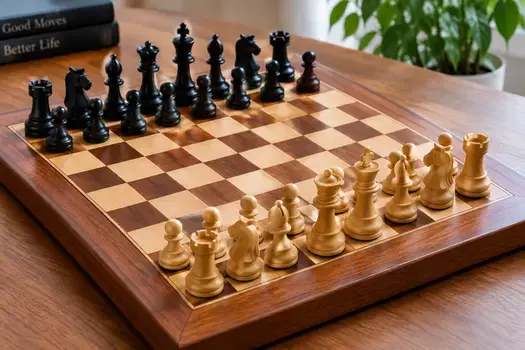
A chess board is the 64-square grid where every battle of strategy unfolds. It consists of eight rows called ranks and eight columns called files. Each square alternates between a light and a dark color.
The board is not just a playing surface. It defines movement patterns, controls spatial awareness, and shapes every opening, middle game, and endgame decision you make.
| Feature | Detail |
| Total Squares | 64 |
| Ranks (Rows) | 8 (numbered 1–8) |
| Files (Columns) | 8 (lettered a–h) |
| Color Pattern | Alternating light and dark |
| Standard Orientation | Light square on each player’s bottom-right corner |
Understanding the geometry of the grid gives you a direct advantage in planning attacks and defending your king.
How Many Squares Are on a Standard Chess Board?
The quick answer is 64 playable squares. But if you count every possible square shape hidden inside the grid — 2×2, 3×3, all the way to 8×8 — the total jumps to 204.
For gameplay, you only need to focus on the 64 individual squares. Each one has a unique algebraic coordinate, like “e4” or “g7,” which players use to record moves through chess notation.
| Square Size | Count on the Grid |
| 1×1 | 64 |
| 2×2 | 49 |
| 3×3 | 36 |
| 4×4 | 25 |
| 5×5 | 16 |
| 6×6 | 9 |
| 7×7 | 4 |
| 8×8 | 1 |
| Total Geometric Squares | 204 |
Knowing coordinates helps you study openings and review games from grandmaster databases.
What Are the Official Chess Board Dimensions?
FIDE, the international governing body for chess, sets strict size rules for tournament play. The square size must fall between 5 cm and 6.5 cm per side. The most common tournament standard is 5.7 cm (2.25 inches) per square [source: FIDE Handbook, fide.com].
The overall board surface then measures roughly 45–52 cm (18–21 inches) across. The king’s height should be about 75% of the square’s width to ensure pieces fit comfortably.
| Measurement | FIDE Standard | Casual Play Range |
| Square Size | 5–6.5 cm | 3.8–6.5 cm |
| Full Board Width | ~45–52 cm | ~30–52 cm |
| King Height | 9.5–10.5 cm | 7–10.5 cm |
| King Base Diameter | ~75% of square width | Flexible |
| Border/Notation Margin | Optional | 1–3 cm typical |
Always match your piece size to your square size. Oversized pieces on small squares cause constant knocking and frustration.
Which Chess Board Materials Last the Longest?
Material choice affects durability, weight, aesthetics, and price. Here is a breakdown of the most popular options you will encounter.
- Walnut and maple wood: The gold standard for serious players. These hardwoods resist warping and age beautifully over decades.
- Rosewood and ebony: Premium choices found in luxury Staunton chess sets. Dense grain patterns create a stunning visual contrast.
- Vinyl and silicone: Lightweight, roll-up options perfect for clubs, schools, and travel. They cost very little and survive rough handling.
- Glass and marble: Decorative display pieces. They look gorgeous on a coffee table but tend to chip and slide during fast games.
- Cardboard and paper: Ultra-budget options for beginners or classroom settings. Expect to replace them within a year.
| Material | Durability | Price Range | Best For |
| Walnut/Maple | Very High | 40–150 | Home and club play |
| Rosewood/Ebony | Extremely High | 100–500+ | Collectors and gifts |
| Vinyl/Silicone | High | 5–25 | Travel and tournaments |
| Glass/Marble | Moderate | 30–200 | Display and décor |
| Cardboard | Low | 2–10 | Beginners and classrooms |
Wood boards with a polyurethane finish handle spills and humidity far better than unfinished options.
How Do You Set Up a Chess Board Correctly?
A proper setup takes under two minutes once you memorize the pattern. Follow these steps every time.
- Orient the board. Place it so each player sees a light-colored square in the bottom-right corner. The phrase “white on right” makes this easy to remember.
- Place the pawns. Fill the entire second rank (row 2 for White, row 7 for Black) with pawns.
- Position the rooks. Rooks go in the four corners — a1, h1, a8, h8.
- Add the knights. Knights sit next to the rooks on b1, g1, b8, g8.
- Set the bishops. Bishops occupy c1, f1, c8, f8.
- Place the queen. The White queen goes on the light square (d1). The Black queen goes on the dark square (d8). Remember: “queen on her own color.”
- Finish with the king. The king takes the remaining square next to the queen — e1 for White, e8 for Black.
| Piece | White Squares | Black Squares |
| Rooks | a1, h1 | a8, h8 |
| Knights | b1, g1 | b8, g8 |
| Bishops | c1, f1 | c8, f8 |
| Queen | d1 (light) | d8 (dark) |
| King | e1 | e8 |
| Pawns | a2–h2 | a7–h7 |
Double-check that both kings face each other on the e-file. This single verification catches most setup errors.
What Is the Difference Between a Chess Board and a Checker Board?
Both grids use an 8×8 layout with alternating colors, which causes frequent confusion. The key differences lie in gameplay, piece count, and square usage.
Chess uses all 64 squares and 32 pieces with six distinct movement patterns. Checkers uses only the 32 dark squares and 24 identical round pieces that move diagonally.
| Feature | Chess | Checkers |
| Grid Size | 8×8 (64 squares) | 8×8 (32 active squares) |
| Pieces per Player | 16 | 12 |
| Piece Types | 6 (king, queen, rook, bishop, knight, pawn) | 1 (man, promoted to king) |
| Movement | Unique per piece type | Diagonal only |
| Capturing | Land on the piece’s square | Jump over the piece |
| Complexity Level | Very High | Moderate |
Many dual-purpose boards print chess coordinates on the border and work perfectly for both games.
How Do You Choose the Right Chess Board for Beginners?
New players need a board that is clear, affordable, and forgiving. Avoid tiny travel sets or oversized decorative boards at first.
Look for these beginner-friendly features:
- Square size between 5–5.7 cm. This fits standard Staunton pieces and gives your hands room to move.
- Printed algebraic notation. Letters and numbers along the edges help you learn coordinates faster.
- Matte finish. Glossy surfaces create glare under bright lights and strain your eyes during long sessions.
- Vinyl or basic wood construction. Both options survive drops, spills, and frequent use without breaking the bank.
| Beginner Priority | Recommended Choice |
| Budget | Vinyl roll-up (8–15) |
| Durability | Silicone tournament mat (10–20) |
| Aesthetics | Walnut/maple wood (35–60) |
| Portability | Magnetic folding set (12–25) |
| Learning Aid | Board with printed coordinates |
The US Chess Federation recommends vinyl roll-up boards for scholastic tournaments because they are lightweight, easy to store, and nearly indestructible [source: US Chess, uschess.org].
What Are the Best Chess Board Brands in 2025?
Brand reputation matters when you want consistent quality and fair pricing. These names earn trust from club players and grandmasters alike.
- House of Staunton: The most recognized name in premium wooden sets. Their boards pair hand-selected walnut and maple with exacting FIDE proportions.
- DGT (Digital Game Technology): The official supplier for FIDE World Championship matches. Their electronic boards record moves automatically and connect to analysis software.
- Square Off: A smart board brand that moves pieces on its own using internal robotics. Great for solo practice against AI opponents.
- Chess House: A reliable retailer offering a wide range of boards at every price point, from vinyl to luxury ebony.
- WE Games: Budget-friendly wooden and leatherette options that punch above their weight in quality.
| Brand | Price Range | Standout Feature | Best For |
| House of Staunton | 50–500+ | Handcrafted wood | Collectors and serious players |
| DGT | 100–600 | Electronic move recording | Tournament and online integration |
| Square Off | 200–400 | Robotic piece movement | Solo practice and tech lovers |
| Chess House | 10–200 | Wide selection | All skill levels |
| WE Games | 15–80 | Affordable quality | Casual and gift buyers |
How Much Should You Spend on a Quality Chess Board?
Your budget should match your commitment level. A casual player who enjoys a weekly game does not need a $300 handcrafted set.
- Under $20: Vinyl and silicone boards. Perfect for kids, classrooms, and park games.
- 20–60: Entry-level wood or leatherette boards. A massive upgrade in feel and appearance.
- 60–150: Mid-range hardwood boards with inlaid squares and notation borders. The sweet spot for most home players.
- 150–500+: Premium artisan boards with exotic woods, weighted bases, and matching Staunton pieces. These double as heirloom gifts.
| Budget Tier | What You Get | Who It’s For |
| Under $20 | Vinyl/silicone, no-frills | Students, travelers |
| 20–60 | Basic wood or leatherette | Casual home players |
| 60–150 | Hardwood, inlaid, notation | Dedicated hobbyists |
| 150–500+ | Exotic wood, artisan craft | Collectors, gifts |
Spend the most on the pieces rather than the board if your budget is tight. Weighted, felt-bottomed Staunton pieces transform even a cheap vinyl mat into a pleasant playing experience.
Can a Digital Chess Board Replace a Physical One?
Digital boards like DGT e-Boards and Square Off Neo bridge the gap between over-the-board play and online chess platforms. They detect piece placement through sensors and transmit moves to apps like Chess.com and Lichess in real time.
The advantages are clear. You get the tactile feel of moving real pieces while enjoying online matchmaking, engine analysis, and game recording. The drawback is cost — most smart boards start above $150.
| Feature | Physical Board | Digital Smart Board |
| Tactile Feel | Excellent | Excellent |
| Online Play | No | Yes |
| Move Recording | Manual notation | Automatic |
| Engine Analysis | No | Yes (via app) |
| Price | 10–500 | 150–600 |
| Setup Time | Instant | 2–5 minutes (Bluetooth pairing) |
For most players, a physical board and a phone or tablet running a chess app deliver the best of both worlds at a fraction of the cost.
How Do You Clean and Maintain Your Chess Board?
Proper care keeps your board looking new for decades. Different materials need different approaches.
- Wood boards: Wipe with a slightly damp microfiber cloth after each session. Apply a thin coat of furniture wax or mineral oil every three to six months to prevent drying and cracking. Never soak wood in water.
- Vinyl and silicone: Wash with warm soapy water and air dry flat. These materials tolerate more aggressive cleaning than wood.
- Glass and marble: Use a glass cleaner or stone-safe polish. Dry immediately to prevent water spots.
- Electronic boards: Follow the manufacturer’s instructions. Keep liquids away from sensor areas and charging ports.
| Material | Cleaning Method | Frequency | Avoid |
| Wood | Damp cloth + wax | Weekly + quarterly | Soaking, harsh chemicals |
| Vinyl/Silicone | Soapy water | As needed | Sharp objects, heat |
| Glass/Marble | Glass/stone cleaner | Weekly | Abrasive scrubbers |
| Electronic | Dry cloth only | After each use | Water, solvents |
Store your board flat in a dry room away from direct sunlight. UV exposure fades wood finishes and warps vinyl over time.
What Chess Board Size Do Tournaments Require?
FIDE regulations specify that the square size must measure between 5 cm and 6.5 cm, with 5.7 cm being the most widely adopted standard for international events [source: FIDE Handbook, fide.com]. The king must stand 9.5–10.5 cm tall with a base diameter no wider than 75% of the square.
US Chess Federation events follow nearly identical guidelines. Tournament directors typically provide DGT or vinyl roll-up boards that meet these specifications.
| Tournament Level | Square Size | King Height | Board Type |
| FIDE International | 5.7 cm (standard) | 9.5–10.5 cm | DGT electronic or vinyl |
| USCF National | 5.7 cm | 9.5–10.5 cm | Vinyl or wood |
| Scholastic/Youth | 5–5.7 cm | 7.5–10 cm | Vinyl roll-up |
| Casual Club | Flexible | Flexible | Any |
If you plan to compete, practice at home with a board that matches tournament dimensions. Muscle memory for piece spacing transfers directly to competition.
Start Your Next Game the Right Way
Every great game begins before the first move. A properly oriented, well-maintained board sets the tone for sharp focus and fair play. Whether you grab a $10 vinyl roll-up for the park or invest in a handcrafted walnut set for your study, the rules of setup and care stay the same.
Pull your board out of the closet tonight. Set up the pieces using the steps above. Play a quick game with a friend or challenge a computer opponent. The 64 squares hold more possibilities than atoms in the observable universe — and your next brilliant combination is waiting on one of them.