demographic transition model
Introduction
Have you ever wondered why some countries have tons of kids and others have tons of grandparents? It is a fascinating question. The answer lies in a tool called the demographic transition model. This model is like a storybook for countries. It tells us where they have been and where they might be going. Demographers, the people who study populations, use it to understand how birth rates and death rates shape our world. When I first learned about it, everything clicked. I finally understood why my grandmother’s family had eight kids and my family stopped at two. It is not random. It follows patterns. And those patterns are what we call the demographic transition model. In this article, we are going to walk through each stage together. We will look at real countries that fit each part of the model. We will talk about what life is like for people in those places. By the end, you will see the world’s population in a whole new light.
The Complete Demographic Transition Model Reference Table
Before we dive into each stage, here is a handy table that summarizes the entire model. Keep this as your roadmap as we explore each part in detail.
What Is the Demographic Transition Model?
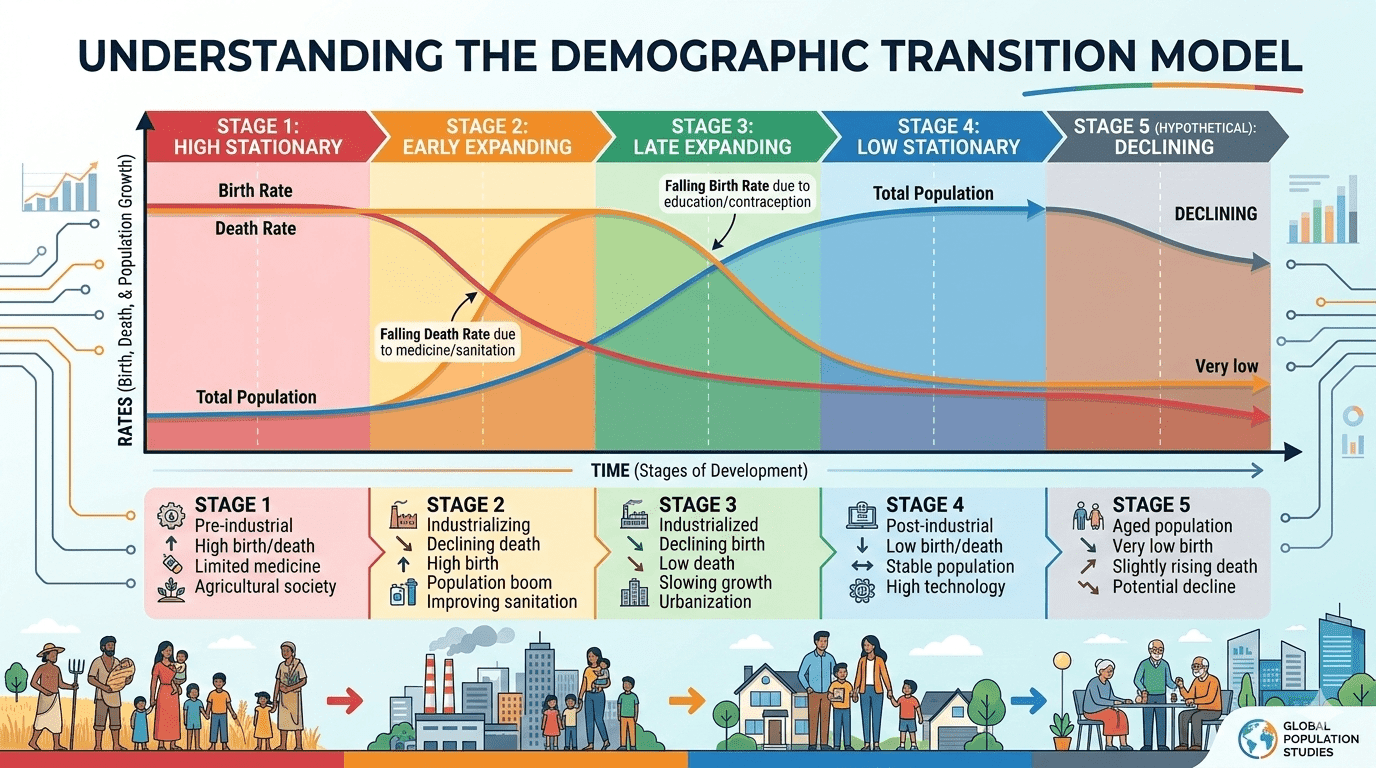
Let us start with the basics. The demographic transition model is a tool that shows how populations change over time. It was first developed in 1929 by a man named Warren Thompson . He looked at how countries in Europe and North America had changed over the previous 200 years. He noticed patterns. Birth rates and death rates were not random. They shifted as countries developed. The demographic transition model definition is simple: it describes the shift from high birth and death rates to lower birth and death rates as a country develops economically . Think of it as a country’s life story. It starts with lots of births and lots of deaths. It ends with few of both. In between, there is a period of rapid growth. That growth period is what has shaped our modern world. The model helps us understand why some populations are booming while others are shrinking.
Stage 1: The Pre-Industrial World
Stage 1 is like stepping back in time thousands of years. In this stage, both birth rates and death rates are very high . They bounce around a lot depending on conditions. When food was plentiful, more people survived. When famine or disease struck, many died. Life was hard. People had many children because so few survived to adulthood. Children were also needed to work on farms and help the family survive . There was no birth control. There was no modern medicine. If you got sick, you hoped for the best. Today, no country is in Stage 1 . The last societies in this stage were remote tribal groups in places like the Amazon rainforest . But looking at Stage 1 helps us appreciate how far we have come. It shows us the starting point of the human journey.
Here is what life looked like in Stage 1:
- High infant mortality: Many children died before age five.
- No family planning: People had as many children as nature provided.
- Frequent famines: Food supply was unreliable.
- Deadly diseases: Epidemics swept through communities regularly.
- Short life expectancy: Most people did not live past 40.
- Subsistence living: Everyone worked just to survive.
Stage 2: The Population Explosion Begins
Stage 2 is where things get exciting. The death rate drops dramatically . But the birth rate stays high. This creates a huge gap. More people are being born than are dying. The population explodes. Why does the death rate fall? Several things happen. Sanitation improves. People get clean water. Food becomes more secure and better transported . Medical care advances, even in basic ways. Vaccinations appear. Child mortality drops. Parents start to notice that more of their children are surviving. But they keep having large families out of habit and tradition. Countries in Stage 2 today include Niger, Afghanistan, and Yemen . These nations are growing incredibly fast. They face challenges. They need more schools, more hospitals, more jobs. Their populations are young and growing.
Reasons death rates fall in Stage 2:
- Clean water: Better sanitation stops deadly diseases.
- Food security: Improved farming and transport prevent famine.
- Medical advances: Vaccines and basic care save children.
- Public health: Governments start investing in health systems.
- Nutrition: People eat better and are stronger.
- Maternal care: More mothers survive childbirth.
Stage 3: The Slowdown
Stage 3 is when the birth rate finally starts to fall . The death rate stays low. So the gap between them narrows. Population growth slows down. Why do people start having fewer children? Several things change. Countries urbanize. People move to cities where children are more expensive to raise. You cannot just send them to work in the fields. They need schooling. Women gain more opportunities. They go to school longer. They enter the workforce. They marry later . Family planning becomes available. People start to realize that having two children is enough. Those two will likely survive. Mexico and India are classic examples of Stage 3 countries . They are still growing, but more slowly than before. Their populations are getting older on average.
Why birth rates drop in Stage 3:
- Urbanization: City life makes large families costly.
- Women’s education: Educated women choose smaller families.
- Workforce changes: Children are no longer economic assets.
- Family planning: Contraception becomes available and accepted.
- Lower infant mortality: Parents know their kids will survive.
- Material desires: People want things, not just large families.
Stage 4: The Stable Society
Welcome to Stage 4. This is where birth rates and death rates are both low . The population is stable. It grows very slowly, if at all. This is the stage of developed countries. Think of the United States, Canada, and the United Kingdom . People in Stage 4 have small families by choice. Two children is common. Sometimes even one. Women are fully integrated into the workforce. Contraception is widely available and accepted. Education levels are high. People marry later or not at all. The population is older on average. There are fewer young people and more older people. Life expectancy is high. People live into their 80s regularly. Stage 4 societies are prosperous. But they face their own challenges. The workforce may start to shrink. There are fewer young people to support the growing number of elderly.
Characteristics of Stage 4 countries:
- Small families: Two children is the norm.
- High life expectancy: People live into their 80s.
- Women in workforce: Female labor force participation is high.
- Late marriage: People marry in their late 20s or 30s.
- Good healthcare: Medical systems are advanced.
- Stable population: Growth is near zero.
Stage 5: The Uncertain Future
Stage 5 is the newest addition to the model. Not everyone agrees it should be a separate stage. But it describes a real phenomenon. In Stage 5, the birth rate falls below the death rate . The population starts to shrink. This is happening in countries like Japan, Germany, and Italy . Why does this happen? People have very few children. Sometimes they have none. Life expectancy keeps rising. So there are lots of older people and not enough young people to replace them. This creates big challenges. Who will work? Who will pay taxes? Who will care for all the elderly? Japan is a perfect example. Over 28 percent of its population is over 65 . The fertility rate is just 1.3 children per woman. That is far below the 2.1 needed to keep the population stable. Stage 5 countries are experimenting with solutions. Some encourage immigration. Some offer cash incentives for having babies. Some are turning to robots and automation. The future of Stage 5 is still being written.
Challenges facing Stage 5 countries:
- Shrinking workforce: Not enough young workers.
- Elderly care costs: Pensions and healthcare strain budgets.
- Economic slowdown: Fewer workers mean less growth.
- Innovation pressure: Countries turn to technology to fill gaps.
- Immigration debates: Some want more immigrants, others resist.
- Cultural shifts: Societies must adapt to fewer young people.
Real-World Example: Nigeria’s Transition
Let us make this real with an example. Nigeria is currently moving from Stage 2 to Stage 3 . It is a fascinating case. Thirty years ago, Nigeria had high birth rates and high death rates. Healthcare was poor. Many children died. Today, things are changing. Death rates have fallen thanks to better healthcare and sanitation. But birth rates remain high. Over 43 percent of Nigeria’s population is under 15 years old . That is a huge number of young people. This creates what demographers call population momentum. Even if families start having fewer children tomorrow, the population will keep growing for decades. Why? Because all those young people will soon have their own children. Nigeria faces huge challenges. It needs schools for millions of kids. It needs jobs for when they grow up. It needs healthcare and housing. But it also has an opportunity. If it can educate and employ all those young people, they could drive massive economic growth. That is the demographic dividend. Nigeria’s future hangs in the balance.
Real-World Example: Japan’s Decline
Now let us look at the other end of the spectrum. Japan is firmly in Stage 5 . Its story is almost the opposite of Nigeria’s. Thirty years ago, Japan was already developed. It had low birth rates and low death rates. Today, the birth rate has fallen even further. It is now just 1.3 children per woman. The death rate has ticked up slightly, not because people are less healthy, but because the population is so old. Over 28 percent of Japanese are over 65 . This creates a huge dependency ratio. There are fewer working-age people to support all the retirees. Pensions are strained. Healthcare costs are soaring. Some hospitals face shortages of workers. Japan is trying to adapt. It is encouraging automation. It is slowly accepting more immigrants. It is raising the retirement age. But the population is still shrinking. Japan’s experience shows us what many developed countries may face in the coming decades.
Strengths and Limitations of the Model
No model is perfect. The demographic transition model has real strengths. It helps us compare countries. It shows broad patterns. It predicts future trends. Demographers can look at a country’s stage and anticipate its needs . A Stage 2 country will need schools and maternal health services. A Stage 5 country will need elder care and pension reform. The model also helps us understand history. It explains why Europe’s population boomed during the Industrial Revolution. But the model has limitations too . It was based on Western Europe’s experience. It may not perfectly fit other regions. It ignores migration, which can dramatically change populations. It assumes countries will move smoothly through stages. Some get stuck. Some skip stages. The model also does not account for government policies like China’s one-child policy. Or for pandemics like COVID-19. Or for wars and conflicts. So we use the model as a guide, not a rule
The Demographic Transition Model and AP Human Geography
For students enrolled in AP Human Geography, understanding the Demographic Transition Model (DTM) is crucial. In this course, the model is defined as a framework that explains how population growth patterns change as a country becomes more economically developed. It illustrates the long-term shift from high birth and death rates to lower birth and death rates.
To succeed on the AP exam, you must recognize the traits of each stage, identify real-world country examples, and connect the stages to population pyramids. For instance, nations in Stage 2 typically display broad-based population pyramids, reflecting a large proportion of children. In contrast, Stage 5 countries tend to have pyramids with narrower bases and wider upper sections, showing aging populations.
It is also important to link the DTM to the Epidemiological Transition Model (ETM). While the DTM focuses on birth and death rates, the ETM examines changes in causes of mortality. In earlier stages, infectious diseases and poor living conditions were leading causes of death. In more advanced stages, chronic and degenerative illnesses—such as heart disease and cancer—become more common. Understanding how these models interact will strengthen your overall grasp of population geography concepts.
Understanding the Dependency Ratio
Another important concept connected to the Demographic Transition Model is the dependency ratio. This measurement compares the number of people who are typically not in the workforce (children and the elderly) to those who are considered working-age.
In Stage 2 countries, the dependency ratio tends to be high because there are many young dependents. For example, Niger had a dependency ratio of 105 in 2021. This means that for every 100 working-age individuals, there were 105 dependents—a significant economic strain.
Stage 5 countries also face elevated dependency ratios, but for a different reason: aging populations. Japan’s dependency ratio was 57 in 2021. While lower than Niger’s, it still presents economic challenges because caring for elderly populations requires substantial resources.
The most favorable dependency ratios are usually found in the later part of Stage 3 and the beginning of Stage 4. During this period, birth rates have declined, but the population has not yet become significantly older. This situation creates what is known as a demographic dividend—a period when a country has a relatively large workforce compared to dependents. Mexico, with a dependency ratio of 48, is an example of a nation benefiting from this opportunity for economic expansion.
Common Questions About the Demographic Transition Model
What is the Demographic Transition Model in simple terms?
It is a framework that explains how population patterns evolve as a nation develops economically, particularly how birth and death rates move from high levels to lower ones over time.
What are the five stages of the model?
- Stage 1: Both birth and death rates are high, resulting in slow population growth.
- Stage 2: Birth rates remain high, but death rates drop rapidly, causing population growth to accelerate.
- Stage 3: Birth rates begin to decline while death rates stay low, slowing population growth.
- Stage 4: Both birth and death rates are low, and population growth is minimal.
- Stage 5: Birth rates fall below death rates, leading to population decline.
Is the United States in Stage 4?
Yes. The U.S. is generally categorized in Stage 4, with relatively low birth and death rates and slow overall growth.
Which countries are in Stage 2?
Examples include Niger, Afghanistan, and Yemen. These nations experience high birth rates combined with declining death rates, resulting in rapid population increases.
Why does the death rate decrease in Stage 2?
Improvements in sanitation, medical care, nutrition, and public health systems reduce mortality rates significantly during this stage.
What definition is used in AP Human Geography?
In AP Human Geography, the DTM is defined as a model showing how population patterns shift over time due to changes in birth and death rates linked to economic development.
Can countries move backward in the model?
The model generally assumes forward progression. However, wars, pandemics, or severe economic crises can temporarily alter demographic trends.
What defines Stage 5?
Stage 5 is a projected phase where fertility rates drop below mortality rates, leading to shrinking populations. Japan and Germany are often cited as examples.
Why do birth rates decrease in Stage 3?
Factors such as urbanization, increased educational opportunities for women, greater access to contraception, and higher child-rearing costs all contribute to lower fertility rates.
Why is the model useful?
Governments and policymakers use it to anticipate future needs—whether that means expanding schools for young populations or healthcare facilities for aging citizens.
Final Thoughts: Why the Demographic Transition Model Is Important
The Demographic Transition Model is not just an academic theory—it offers insight into real-world population trends. It helps explain why some nations are experiencing rapid growth while others are facing population decline. These demographic shifts influence economic performance, political decisions, and cultural dynamics.
For example, immigration debates in parts of Europe are often tied to aging populations in Stage 5 countries. Meanwhile, discussions about Africa’s youthful workforce reflect Stage 2 characteristics. The model helps connect these global patterns.
Population changes are not random. They tend to follow recognizable stages, each bringing its own challenges and opportunities. These trends affect employment markets, social services, and long-term national planning.
The next time you encounter news about population growth or decline, consider which stage of the model applies. Understanding this framework allows you to interpret demographic patterns with greater clarity and awareness.
| Read More Informative Blogs Like This. Tap Here 👉 Revolutionary Runlhlp Guide |
About the Author